

 Pets aren’t just family; they’re big business.
The expectation for the U.S. is that owners will spend a total of $157 billion by the end of 2025 and will spend close to $200 billion in 2030. In 2024, U.S. pet owners spent over $28 billion buying pet food and supplies online (up 2.6% year-over-year), with projections of pet e-commerce growing to $60 billion by 2030.
To understand the quality of this online experience, we collected UX benchmark metrics on four popular pet websites and mobile apps.
- Chewy
- Petco
- PetMeds
- PetSmart
We computed SUPR-Q® and Net Promoter scores, measured users’ attitudes regarding their experiences, conducted key driver analyses, and analyzed reported usability problems. (Full details are in the downloadable report.)
Benchmark Study Details
In April 2025, we asked 240 U.S. users of pet websites to recall their most recent experience in the previous year with one of the websites on their desktop and mobile app (if applicable).
Respondents completed the eight-item SUPR-Q (which includes the Net Promoter Score), the two-item UX-Lite®, and the SUPR-Qm standardized questionnaires, and they answered questions about their brand attitudes, usage, and prior experiences.
Quality of the Website User Experience: SUPR-Q
The SUPR-Q is a standardized questionnaire widely used for measuring attitudes toward the quality of a website user experience. Its norms are computed from a rolling database of around 200 websites across dozens of industries.
SUPR-Q scores are percentile ranks that tell you how a website’s experience ranks relative to the other websites (50th percentile is average). The SUPR-Q provides an overall score as well as detailed scores for subdimensions of Usability, Trust, Appearance, and Loyalty.
The mean SUPR-Q across pet websites in this study was at the 90th percentile, topping at the 94th percentile for Chewy down to the 82nd percentile for Petco. The quality of the web experience for all four websites was well above average.
Usability Scores
Overall, at the 87th percentile, usability scores were above average for the pet websites. PetSmart had the highest usability score at the 96th percentile. Petco had the lowest usability score, falling at the 79th percentile.
Comments related to usability on Petco included:
“I just wish it was more friendly as far as rebuying went and locating past purchases and again, the filtering can be frustrating as well.”
“Sometimes, I am not sure about shipping prices or tax prices, which causes me to not want to purchase an item.”
Loyalty/Net Promoter Scores
All the pet websites had positive Net Promoter Scores. The average NPS for this group was 42% (substantially more promoters than detractors), which is well above average for Net Promoter Scores in our SUPR-Q database (−6% in 2Q 2025). Chewy was the most likely to be recommended, with an NPS of 57%. PetSmart was the least likely to be recommended, with an NPS of 28%.
Looking at SUPR-Q subscales, we see that the pet websites had high scores for Loyalty, ranging from the 97th percentile for Chewy to the 89th percentile for PetSmart.
Unsurprisingly, ratings of intent to keep using these websites were high (all over 8.5 on a 0–10-point scale, Figure 1).

Figure 1: Likelihood to continue using the websites (90% confidence intervals).
Comments related to NPS and loyalty included:
“I have had zero issues with any order I’ve ever made from the Chewy website and zero issues with any product I’ve received from my orders. Their prices are competitive, products are trustworthy, and their brand is reputable. I have no complaints and strongly recommend them to any pet owner.” — Chewy
“I use Petco for a lot of horse and dog treatments and am very likely to recommend my friends and colleagues order the same products from them as they are relatively cheap, easy to find, and come pretty quick. They also normally have cheap or free shipping.” — Petco
“I have recommended this site to people I know. They have a lot of products available for dogs and cats, and the prices are so much cheaper than getting meds at the vet. I like that you can look up a med/product by name, if you remember it, or you can browse based on either category of product or condition it treats. They also often have sales and coupons that help save even more money. This company has been around a long time so I know they are trustworthy and reputable.” — PetMeds
“I give it a 10 because they have everything you could possibly need for just about any kind of pet with decent prices as well as delivery.” — PetSmart
Websites and Mobile App Usage
As a part of this benchmark, we asked respondents how they accessed the pet websites. All respondents reported using their desktop/laptop computers (this was a requirement for participation in the survey). Among the respondents, 49% also used mobile apps, and 82% also used mobile websites. Most users reported visiting their pet websites on a desktop or laptop computer from a few times a month to a few times a year.
Comments about the pet websites related to the mobile app usage included:
“It is a quick responsive app, finds what you’re looking for very quickly. Options to check out are fast.” — Chewy
“It is really easy to use, and it has a nice clean and simple aesthetic to it. I love it!” — Petco
“I’d rate the PetMeds app a 9 out of 10 because it’s super convenient and easy to use, especially for ordering pet medications and health products. The app allows me to quickly reorder prescriptions, check out new products, and track shipments, which makes managing my pet’s health a breeze. The reason I docked one point is that sometimes the search function could be a bit more precise, and there’s the occasional delay in processing prescriptions. But overall, it’s a great tool for pet owners, and it saves a lot of time and hassle!” — PetMeds
“I probably use the mobile app more than the website. But anyway, on the app it’s really easy to make grooming appointments, reschedule if needed. I also really like keeping track of my reward points and various reward offers.” — PetSmart
Key Drivers of UX Quality
To better understand what affects SUPR-Q scores and Likelihood-to-Recommend (LTR) ratings, we asked respondents to rate potentially important attributes of the pet websites on a five-point scale from 1 (Strongly disagree) to 5 (Strongly agree). We conducted key driver analyses (regression modeling) to quantify the extent to which ratings on these items drive (account for) variation in overall SUPR-Q scores and, separately, LTR (the rating from which the NPS is derived; full details are in the downloadable report).
There were 11 significant key drivers, which accounted for 75% of the variation in SUPR-Q scores. The top key driver of the pet website experience was “It’s easy to get auto refills on my pet’s food and supplies” (accounting for 11% of SUPR-Q variation). Other significant key drivers included “I trust the products are safe for my pet” (10%) and “It’s easy to check out on the website” (9%).
We used the same set of predictors to model variation in LTR ratings, with 10 significant drivers accounting for 44% of its variation. The top key driver in this analysis was “I can easily narrow search results down to what I’m interested in” (11%). Other significant key drivers were “I can easily find ratings/reviews for products I’m interested in” (6%) and “The product reviews are helpful (6%).
Figure 2 shows a scatterplot of the importance and opportunity for improvement for seven key drivers (the top SUPR-Q and LTR drivers and drivers that accounted for significant percentages of their variation). The combination of importance and opportunity for improvement provides a basis for prioritizing which key drivers to improve. The importance score is the average of the variance accounted for by the driver in the SUPR-Q and NPS analyses, where larger percentages indicate greater importance. The opportunity score is the top-box percentage for the driver, so smaller percentages indicate greater opportunity for improvement (e.g., it would be harder to improve a driver with a top-box percentage of 100% than one with a top-box percentage of 10%).

Figure 2: Scatterplot of importance and opportunity for improvement of key drivers.
None of these key drivers fell in the upper-left quadrant for drivers of high importance and great opportunity for improvement. The two most impactful drivers (ease of getting auto refills, easily narrow search results) had relatively large top-box scores, but both were less than 50% so there is still room for their improvement.
UX Problems
We examined the verbatim comments to better understand the problems users had. The top themes were out-of-stock items (the most frequently mentioned issue for Chewy, PetMeds, and PetSmart) and cluttered/overwhelming options (the most frequently mentioned issue for Petco). Other problems reported for a majority of the websites included difficult navigation, poor responsiveness, high costs, and issues with product pickup.
Out-of-Stock Items
Respondents reported problems with out-of-stock items for all four websites, and this was the most frequently mentioned issue for Chewy, PetMeds, and PetSmart.
Comments related to out-of-stock items included:
“Sometimes a specific product I want to order is out of stock and takes a while to restock.” — Chewy
“A couple of times when I have used the website it has not shown me when stuff is out of stock unless I try to add it to my cart. Every other time I have used it though there have been no problems.” — PetMeds
“Some items are usually out of stock online and I have to visit the store to get them.” — PetSmart
As shown in Figures 3 and 4, Chewy and PetMeds provide fields for customers to request restock notifications (a strategy that provides a first step toward service recovery), but PetSmart does not (Figure 5).
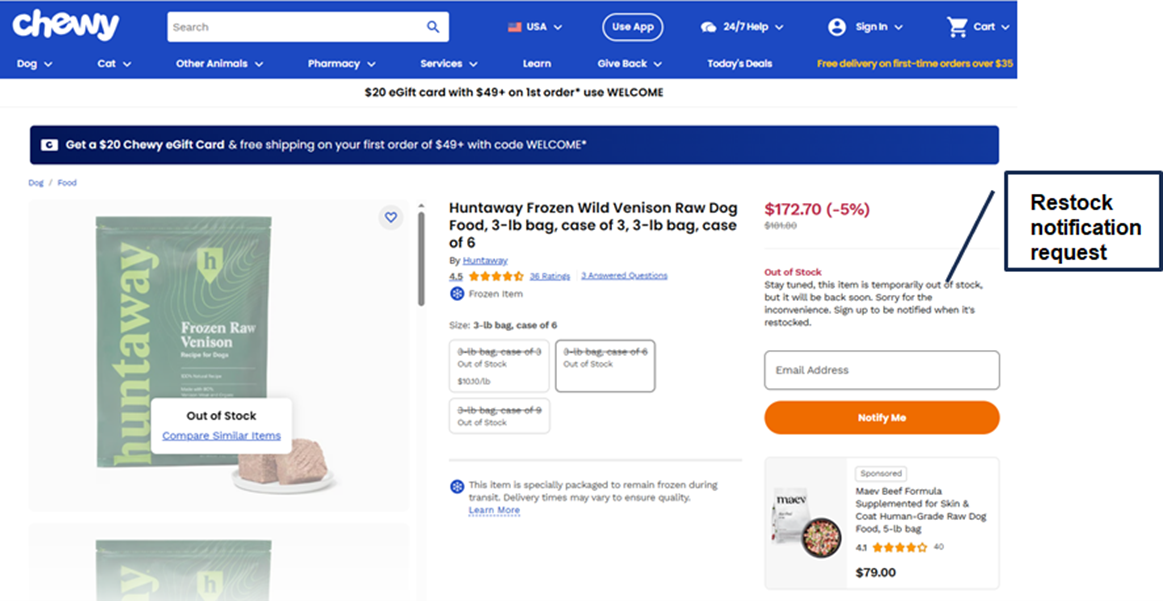
Figure 3: Out-of-stock item on Chewy (with option to request restock notification).

Figure 4: Out-of-stock item on PetMeds (with option to request restock notification).

Figure 5: Out-of-stock item on PetSmart (with no option to request restock notification).
Cluttered/Overwhelming Options
The most frequently mentioned issue for Petco was dealing with cluttered/overwhelming options (Figure 6). Perceived clutter is a major issue in website experiences, whether caused by irrelevant content (ads, videos) or poor design (too much text, visual noise).

Figure 6: Example of clutter (e.g., ads) and overwhelming presentation of items on Petco.
Summary and Takeaways
Pet services are big business in the U.S., with $28 billion spent in 2024 on pet websites. An analysis of the user experience of four major pet websites found:
- The four pet websites provide much better than average user experiences. The pet websites in this study collectively had SUPR-Q scores at the 90th percentile, well above the average 50th percentile. SUPR-Q scores ranged from the 82nd percentile for Petco to the 94th percentile for Chewy. Chewy was most likely to be recommended (NPS of 57%) while PetSmart was the least likely (28%).
- Ease of finding information drives UX scores. Our key driver models accounted for 75% of the variation in SUPR-Q scores and 44% of the variation in LTR ratings. The top key driver of the pet website experience was “It’s easy to get auto refills on my pet’s food and supplies” (accounting for 11% of SUPR-Q variation). Other significant key drivers included “I trust the products are safe for my pet” (10%) and “It’s easy to check out on the website” (9%). The top key driver in the modeling of LTR ratings was “I can easily narrow search results down to what I’m interested in” (11%).
- There are opportunities to improve the top key drivers. Four key drivers significantly accounted for variation in both SUPR-Q and LTR ratings. One of them (“It’s easy to schedule services for my pet online”) had a relatively low effect (though statistically significant) but a high opportunity for improvement (a low top-box score, just over 30%). The top-box scores were higher for the most influential drivers (“It’s easy to get auto refills on my pet’s food and supplies” and “I can easily narrow search results down to what I’m interested in”), but were both lower than 50%, leaving room for improvement.
- The top UX problems reported by users were items being out of stock and cluttered/overwhelming options. For Petco, the most frequent negative user comments were about its cluttered and overwhelming options. Comments about out-of-stock items were the most frequent user complaints for Chewy, PetMeds, and PetSmart. Inspection of out-of-stock items for Chewy and PetMeds showed that they provided short forms with which users could request notification when the item was back in stock (a first step to service recovery), but PetSmart did not.
For more details, see the downloadable report.