

 You put in the grueling hours. You know what it takes to learn, to persevere, to deliver.
There’s nothing quite like the experience of a PhD program. But perhaps a career in academia isn’t what you’re looking for.
You decide to leave academia and apply your skills in the UX industry. You look for jobs and see that most require a minimum of three to five years of experience.
The PhD program took five years. Don’t those years in the program count as years of job experience? Should they count?
Probably not.
The Value of a PhD
First, we value what a PhD offers. We know. We both went through the experience—while working and raising kids! There’s nothing quite like it. The classwork, teaching, papers, dissertation, defense, and the pile of academic rules.
Averaged over the past decade, about 10% of respondents to the UXPA salary survey had a PhD. That’s seven times higher than the general U.S. population, so it’s a bit of an exclusive club. Although intellectually rewarding, it’s not clear that a PhD pays off financially if entering industry after being a full-time student.
While PhDs do get paid more than their peers with master’s and bachelor’s degrees, the delay before getting into the workforce offsets much of the gain. It takes about 24 years of employment to break even (Figure 1). The value of the PhD to us is not in the clear financial payoff.
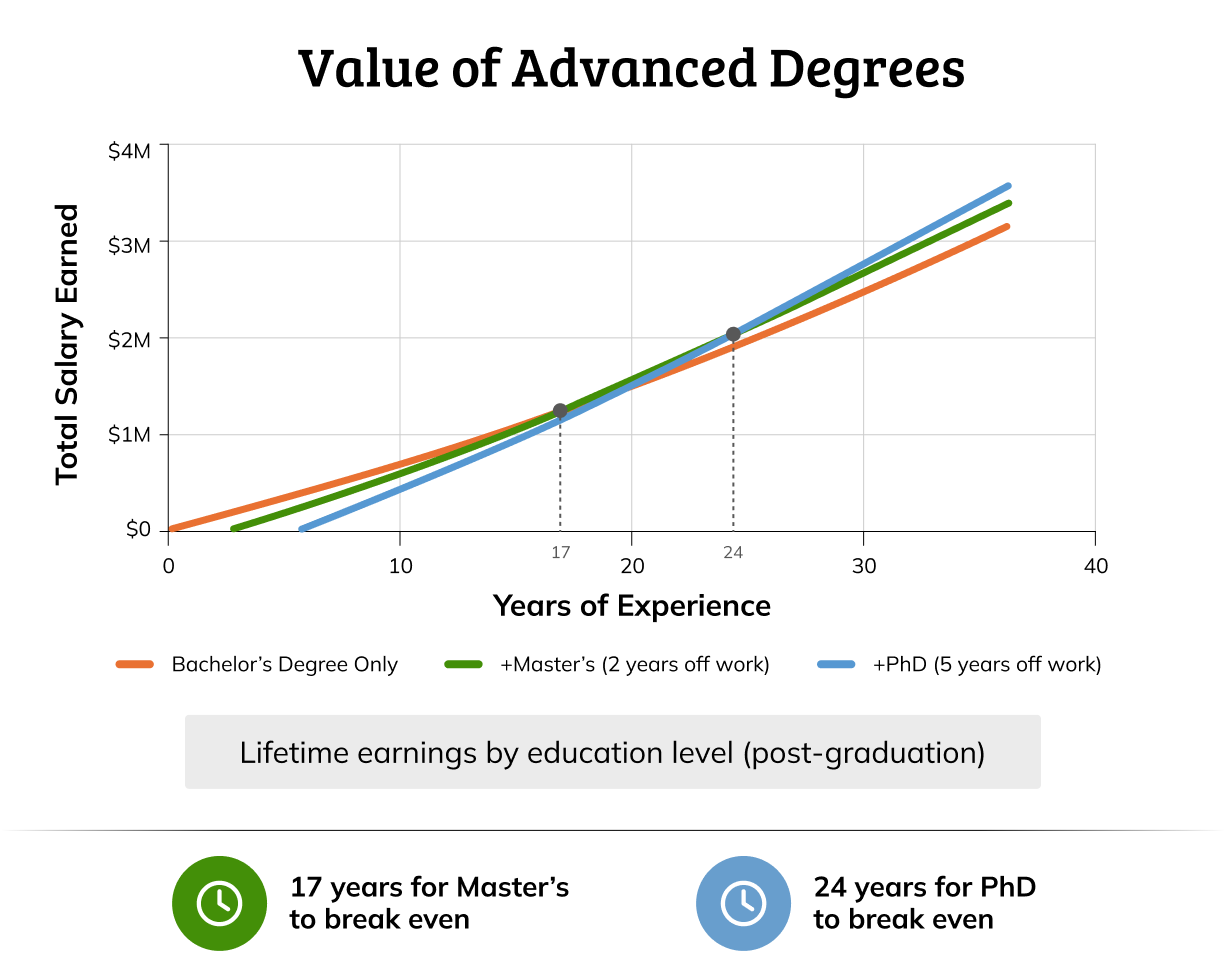
Figure 1: “Lifetime” earnings of PhD and master’s degree recipients vs. not having an advanced degree.
PhD Skills Are Transferable
At MeasuringU, we hire PhDs and probably have one of the highest percentages of PhDs among UX research companies and related fields. (Figure 2).
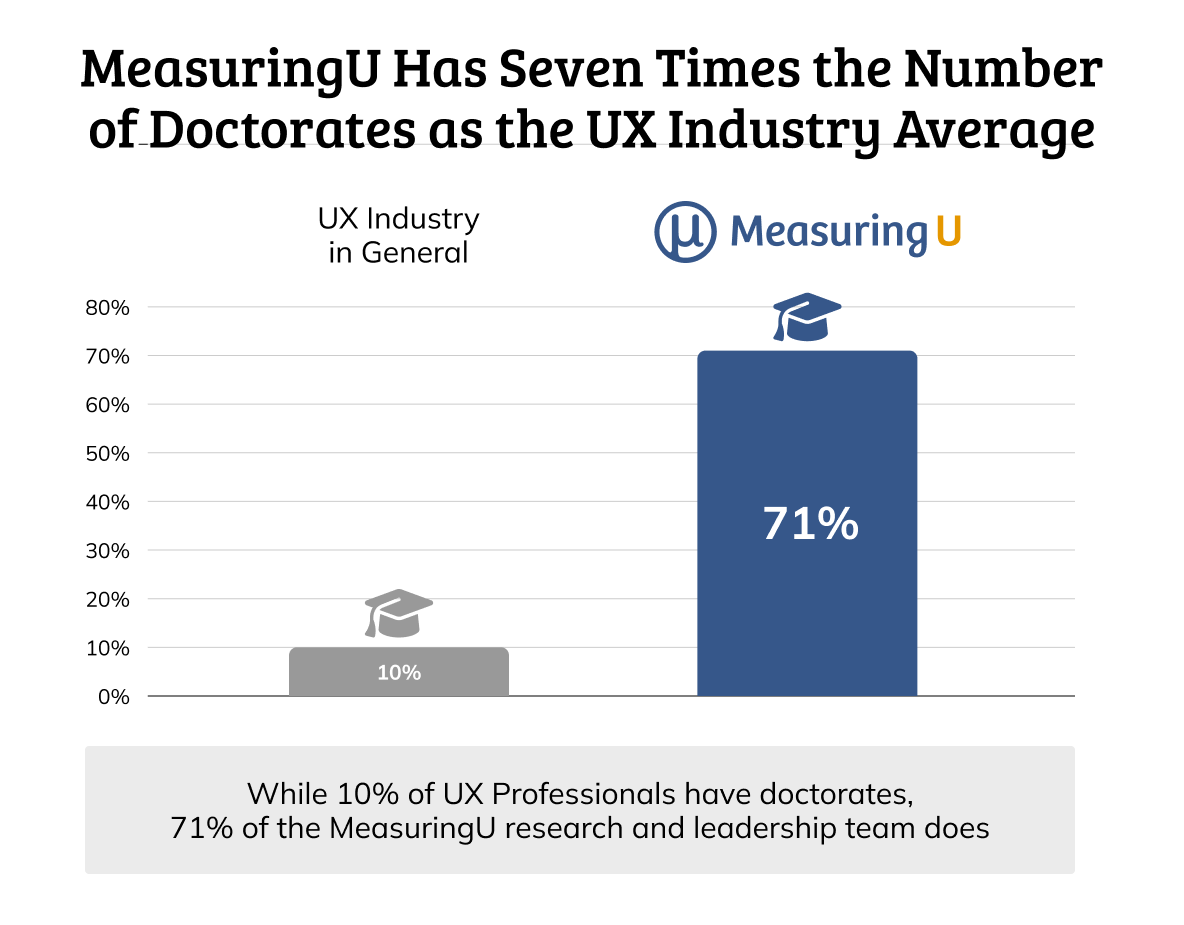
Figure 2: Doctorates at MeasuringU—we like to hire them!
We do this because many of the skills learned in a PhD program are transferable. Table 1 shows examples of the demands of PhD programs and industrial UX research that lead to similar skills.
| Skill / Demand | PhD Program | Industry UX Research |
|---|---|---|
| Designing and running studies | ✅ Extensive | ✅ Extensive |
| Statistical analysis and interpretation | ✅ Rigorous | ✅ Applied |
| Communicating findings to a skeptical audience | ✅ Committees, advisors | ✅ Stakeholders, leadership |
| Working under deadlines | ✅ Milestones, defenses | ✅ Sprint cycles, launches |
| Managing ambiguity in data | ✅ Common | ✅ Constant |
| Writing clearly and persuasively | ✅ Dissertations, papers | ✅ Reports, readouts |
| Defending methodology under scrutiny | ✅ Peer review, committee | ✅ Cross-functional critique |
| Literature synthesis and benchmarking | ✅ Deep | ✅ Applied |
Table 1: Comparisons of skills and demands in PhD programs and industrial UX research.
Where the Comparison Breaks Down
Beyond the overlap shown in Table 1, industry experience adds something different: critical understanding of company politics, constraints, and compromises of conducting research inside a business.
PhD programs rarely teach these skills because they’re not primarily what graduate school is for. Years of professional UX experience expose practitioners to these important skills for navigating the workforce:
Communicating with upper management. Academic communication is oriented toward depth, precision, and scholarly audiences. It’s an entirely different skill to effectively present findings to a vice president who has eight minutes until the next meeting and who has little interest in methods, much less your confidence intervals.
Cost-justifying research. In industry, research doesn’t happen because it’s intellectually interesting. You have to make the business case for why this study is worth three weeks of execution, headcount, and recruiting budget.
Making recommendations. This is probably one of the harder challenges for fresh PhDs. In academic work, published research is the product where the interpretative challenge is to show how the data support or fail to support competing theories. The publication process has its own timeline, which can span over years. In industrial research, the timeline is much faster, and the interpretive challenge is to make connections between results and decisions. You’re expected to be the expert and to use the data as a guardrail when making specific recommendations.
Making decisions with incomplete data. Making recommendations is hard, but making them with incomplete, partial data and small sample sizes is even harder, and it’s pretty much guaranteed to be part of the job. Academic research is built around the idea that you don’t publish until the evidence is sufficient. Industry doesn’t wait. Researchers routinely must make actionable calls with n = 6, two weeks of data, and a product manager asking, “So what do we do?” Being comfortable with that is a skill that only comes from real-world practice.
Navigating organizational dynamics. Whose priorities take precedence? What happens when engineering ignores your findings? How do you influence a roadmap when you don’t own it? These questions don’t appear on qualifying exams.
Learning to say “no.” As a student, you’re expected to do everything you’re asked to do without any significant pushback. When you join an industrial team as a UX researcher, you can count on being asked to do more than you can. Learning how to say “no” in socially and politically savvy ways becomes an important skill.
Learning to deal with the “PowerPoint problem.” Translating nuanced research into a compelling, executive-ready slide deck (one that lands the insight without losing the truth) is a learned, practiced skill. Many new PhDs have never had to do it, and it shows. This is not writing an academic paper where findings and conclusions come after the methodological details. Stakeholders assume you know how to do the work. You need to learn to start with the findings and recommendations and then provide the supporting details.
Being okay with “good enough” research. Graduate training optimizes for rigor. Industry optimizes for decision-making. Sometimes the right study is a fast-and-dirty five-session usability test, not a mixed-methods longitudinal study. Knowing when to go “good enough” (and not feeling bad about it) takes time and context that academia doesn’t provide.
Do Years of Experience Count Toward a PhD?
While we’re sympathetic to PhD applicants who want their years of program experience to count as industry experience, should the inverse also hold?
That is, if a PhD counts as five years of industry experience, should five years of UX research experience earn an honorary doctorate?
Most PhDs would immediately bristle at this suggestion, and they’d be right to do so. Years of industry work, however excellent, don’t replicate what a doctoral program demands: the years of independent scholarship, the depth of the literature review, the grueling process of designing and defending original research, the personal reckoning of being solely responsible for a body of work over years. Nobody gets a PhD by accident or by accumulating time. It’s a specific, demanding thing.
But the fact that this inverse is obviously false signals that the original equivalence is weaker than it sounds. Despite some overlapping skills, the demands of the two research contexts are very different.
The Bottom Line
A PhD and years of industry experience are not the same thing. They produce overlapping but distinct skill sets, so treating them as interchangeable flattens what is genuinely valuable about each.
But that’s not the same as saying a PhD doesn’t matter in industry. For certain roles—particularly in applied research firms where methodological depth, statistical rigor, and the ability to defend findings under scrutiny are core to the work (like MeasuringU!), a PhD is a genuine competitive advantage. It’s not a substitute for industry experience, but it’s a strong foundation to build on, and the gap closes quickly for PhDs who are self-aware about what they still need to learn.
If you have a PhD, be proud of it. Use it. The methodological foundation you built is real and hard to replace.
The PhD is a head start on the craft. Experience is a head start on the context. The best industrial researchers, eventually, have both.